Connecting ideas, communities, and innovation to transform education worldwide, driving inclusive, resilient, and future-ready learning for every learner.
Email has been the backbone of business communication for decades, but it is also one of the weakest links in cybersecurity. Every year, millions of phishing attempts, malware-laced attachments, and business email compromise (BEC) attacks put organizations at risk. According to industry studies, over 90% of cyberattacks begin with an email, which makes it clear why securing this channel is a top priority for IT leaders and business owners alike.
The challenge is that email security is not a single solution—it requires a combination of technology, processes, and user awareness. Below, we explore the top five tips for solving the email security problem, with practical steps you can implement right away.
Email is the front door to your business—if you don’t secure it, you’re leaving the key under the mat for cybercriminals.
-Alex Morgan
Email will continue to be a critical communication tool, but it doesn’t have to be the weak link in your cybersecurity strategy. By making security a shared responsibility between technology and people, organizations can stay ahead of attackers.
In today’s world, where cyber threats are growing more sophisticated by the day, protecting email is not optional—it’s essential. The good news is that with the right combination of awareness and action, you can turn your inbox from a vulnerability into a secure and trusted communication channel.
At a Glance
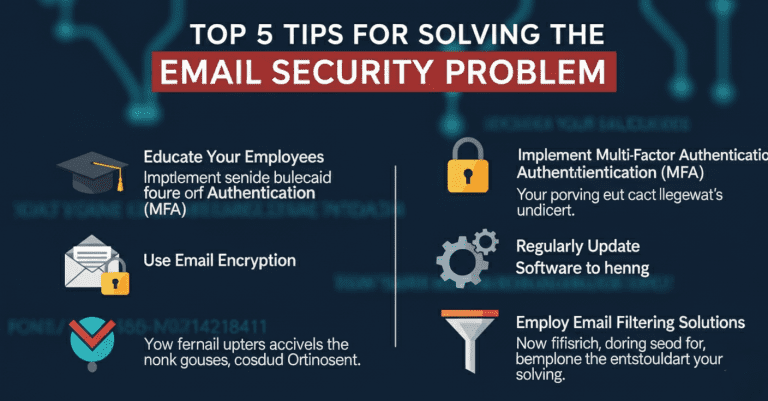
◎ Enable Multi-Factor Authentication (MFA): Add an extra layer of protection beyond passwords.
◎ Train Employees: Regular phishing awareness and simulations make staff your strongest defense.
◎ Use Advanced Filtering: Block phishing, malware, and spoofed emails before they hit the inbox.
◎ Keep Systems Updated: Patch vulnerabilities quickly to stay ahead of attackers.
◎ Encrypt Sensitive Emails: Ensure confidential data stays secure in transit.
◎ Adopt a Security Culture: Combine technology with awareness for lasting protection.
Actionable Insights
What This Means for Email Security?
🔐 Mandate Multi-Factor Authentication (MFA): Organizations must go beyond password protection by enforcing MFA across all user accounts. This ensures that even if login credentials are stolen through phishing or data leaks, attackers cannot easily gain access to email systems.
📧 Prioritize Employee Awareness: Since most breaches begin with human error, building a culture of vigilance is essential. Companies should invest in ongoing training and phishing simulations to empower staff to identify and report suspicious messages before damage occurs.
🛡️ Strengthen Filtering and Gateways: Security leaders should deploy advanced spam filters and threat detection solutions that stop malicious emails before they reach employees. This proactive layer reduces the dependency on human decision-making and minimizes the risk of successful phishing attempts.
⚙️ Commit to Continuous Updates: IT teams must establish clear patch management policies to keep operating systems, email clients, and mobile devices up to date. Closing these gaps quickly prevents attackers from exploiting vulnerabilities in outdated systems.