


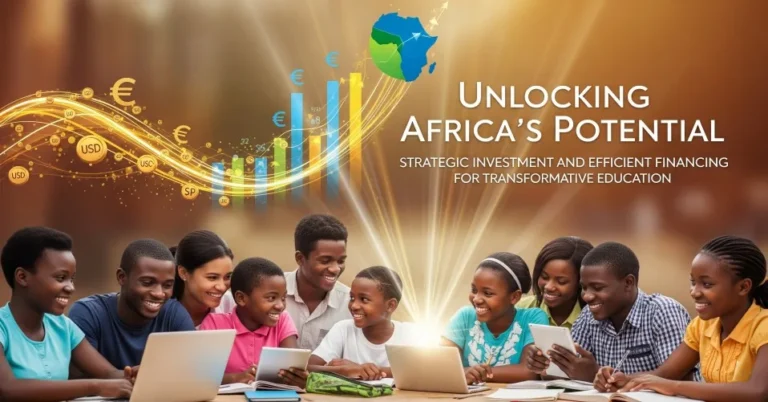
Unlocking Africa’s Potential – Strategic Investment and Efficient Financing for Transformative Education

Executive Summary
Education is the bedrock of sustainable development, yet in Africa, its transformative power is consistently undermined by inadequate and inefficient financing. Despite international and continental commitments, a significant majority of African nations fall short of globally endorsed education spending benchmarks, resulting in a staggering annual financing gap of approximately $70 billion in Sub-Saharan Africa alone. This chronic underinvestment, coupled with inefficiencies in expenditure and a heavy reliance on household contributions, directly fuels the learning crisis, perpetuates inequalities, and jeopardises the continent’s demographic dividend. This policy brief outlines the critical dimensions of Africa’s education financing challenge, explores its root causes and far-reaching impacts, and proposes a comprehensive set of policy recommendations. These recommendations emphasise increased domestic resource mobilisation, enhanced spending efficiency, innovative financing mechanisms, and strengthened accountability, all aimed at ensuring sustainable and equitable funding for quality education across Africa.
When education is financed with vision and equity, it stops being a cost and becomes the most transformative investment Africa can make in its future.
-Jordan Hayes
1. Introduction: The Unfulfilled Promise of Education Financing
The aspirations for a prosperous and integrated Africa, as articulated in the African Union’s Agenda 2063 and the achievement of the Sustainable Development Goal 4 (SDG 4), are inextricably linked to the provision of quality education for all. Recognising this, African nations, alongside international partners, have committed to ambitious education financing benchmarks: allocating at least 4-6% of Gross Domestic Product (GDP) and/or 15-20% of total public expenditure to education. These benchmarks, reaffirmed through declarations like the 2015 Incheon Declaration and the recent Nouakchott Declaration (which expanded the GDP benchmark to 6-7%), underscore a collective understanding of education’s pivotal role.
However, the reality on the ground paints a stark picture of underinvestment. Many African governments consistently fail to meet these targets, leading to a severe and persistent education financing crisis.13 This brief argues that addressing this challenge is not merely about increasing spending but also about ensuring every dollar invested translates into tangible improvements in learning outcomes and equitable access. Without a fundamental shift in how education is financed and managed, Africa risks leaving millions of its children behind and failing to harness its immense human potential.
2. The Magnitude of the Challenge: A Persistent Funding Gap
The data reveals a systemic and widespread problem of inadequate education financing across Africa:
◎ Widespread Failure to Meet Benchmarks: Only about one-third of African countries met globally endorsed education funding benchmarks in recent years, with this figure declining to just one-quarter by 2022 and 2023. Fourteen African countries failed to meet any of the benchmarks in a single year over the past decade.
◎ Massive Financing Gap: Sub-Saharan Africa faces an annual education financing gap of approximately $70 billion, representing the largest share of a $97 billion global gap needed to achieve SDG 4 in low- and lower-middle-income country
◎ Low Per-Learner Spending: Governments in these regions allocate a paltry average of $55 per learner annually, starkly contrasting with $8,543 in high-income countries.
◎ Stagnant Per Capita Spending: Despite some increases in overall education funding, the median annual education spending per capita in Africa has stagnated at around USD$100 over the past decade.
◎ Heavy Household Burden: Families across Africa shoulder a significant and often crippling burden in funding education, absorbing an average of 27% of total education spending. This out-of-pocket expenditure creates a major barrier to access and retention, particularly for the poorest households
◎ Declining Aid to Education: Official Development Assistance (ODA) for education in sub-Saharan Africa declined by 23% from 2020 to 2021, and its proportion of total development aid has also fallen, reflecting shifting donor priorities.
3. Root Causes and Compounding Factors
The persistent underfunding and inefficiency in education financing in Africa stem from a complex interplay of factors:
◎ Limited Fiscal Space and Macroeconomic Pressures: Many African countries face significant fiscal constraints, including high national debt burdens. Debt servicing often consumes a larger share of national budgets than education, leading to austerity measures that cut public spending on vital social services like education.
◎ Inefficient Spending: Even where funds are allocated, inefficiencies in expenditure reduce their impact. Africa is the least efficient region in government education spending, with average efficiency scores of 58% for primary and 41% for secondary education. This implies that a significant portion of allocated funds does not translate into improved learning outcomes. Common inefficiencies include poor resource allocation, weak financial management, and corruption.
◎ Weak Domestic Resource Mobilisation: Many African countries have narrow tax bases, low tax-to-GDP ratios, and struggle with illicit financial flows, limiting their ability to generate sufficient domestic revenue for public services.
◎ Lack of Transparency and Accountability: Insufficient transparency in education budgeting and spending makes it difficult to track funds, identify leakages, and ensure accountability. Disaggregated data on education spending is often unavailable.
◎ Political Prioritisation: Despite high-level commitments, education may not always receive the necessary political prioritisation in national budgets, especially when competing with other pressing sectors or short-term economic goals.
◎ Rapid Population Growth: The fastest-growing child population globally in Sub-Saharan Africa places immense fiscal pressure on governments to meet the escalating demand for education services.
◎ Impact of Crises: Climate-related emergencies and conflicts divert resources, damage infrastructure, and disrupt education delivery, further straining already limited budgets.
4. Far-Reaching Impacts on Education and Development
The consequences of inadequate and inefficient education financing are severe and far-reaching:
◎ Perpetuation of the Learning Crisis: Insufficient funding directly impacts teacher salaries, training, and availability of learning materials, exacerbating the learning crisis where millions of children are in school but not learning.
◎ Exacerbated Inequalities: The burden of out-of-pocket expenses disproportionately affects children from the poorest households, forcing them out of school or into lower-quality education, thereby widening existing educational and socio-economic disparities.
◎ Teacher Shortages and Low Quality: Underfunding leads to low teacher salaries, poor working conditions, and limited professional development opportunities, contributing to teacher shortages and a decline in teacher quality.
◎ Dilapidated Infrastructure and Lack of Resources: Schools often lack basic amenities, adequate classrooms, and essential learning materials, creating an unconducive learning environment.
◎ Hindered Human Capital Development: Chronic underinvestment in education undermines the development of a skilled workforce, limiting productivity, innovation, and ultimately, economic growth and poverty reduction.
◎ Compromised SDG 4 Achievement: Without a significant and sustained increase in funding, Africa will not achieve its commitments to inclusive and equitable quality education by 2030.
5. Policy Recommendations: Towards Sustainable and Equitable Education Financing
Addressing Africa’s education financing crisis requires a bold, multi-pronged approach that combines increased investment with enhanced efficiency and accountability.
5.1. Increase Domestic Resource Mobilisation for Education:
◎ Expand and diversify national tax bases and improve tax collection efficiency: African governments should strive to increase their tax-to-GDP ratio to at least 15%, ensuring that affluent corporations and individuals contribute fairly. This includes addressing illicit financial flows and integrating the informal economy into the tax system.
◎ Prioritize education in national budgets: Governments should commit to allocating at least 4-6% of GDP and/or 15-20% of total public expenditure to education, as per international benchmarks. The recent Nouakchott Declaration’s expansion of the GDP benchmark to 6-7% should be a guiding principle.
5.2. Enhance Efficiency and Equity in Education Spending:
◎ Improve public financial management (PFM) and budget transparency in the education sector: Implement robust PFM systems to track education spending from allocation to utilization. Publish regular, disaggregated data on education budgets and actual expenditures (by level, type, and geographic area) to enable oversight and accountability.
◎ Implement evidence-based, cost-effective interventions: Prioritize investments in programs proven to improve learning outcomes, such as foundational literacy and numeracy initiatives, teacher training, and provision of learning materials. Focus on optimising resource allocation to the classroom level.
◎ Eliminate all forms of school fees and hidden costs: Ensure genuinely free and compulsory primary and secondary education, removing tuition fees, levies, and indirect costs (e.g., uniforms, textbooks) that burden households and exclude the poorest children.
5.3 Explore and Leverage Innovative Financing Mechanisms:
◎ Advocate for debt restructuring and relief to free up fiscal space for education: International financial institutions and creditor governments should consider debt swaps for education, where debt is forgiven in exchange for commitments to invest saved funds in education.
◎ Explore new and blended finance mechanisms: Investigate the potential of education bonds, social impact bonds, and public-private partnerships (PPPs) that attract private and philanthropic funding while ensuring equitable access and quality in public education.
◎ Strengthen partnerships with the private sector and philanthropy: Engage the private sector not just for funding, but also for expertise, technology, and in-kind contributions that align with national education priorities.
5.4. Strengthen Accountability and Governance:
◎ Foster inter-ministerial coordination and collaboration: Enhance dialogue and joint planning between Ministries of Education, Finance, and Planning to ensure education is a central component of national development strategies and receives adequate, predictable funding.
◎ Empower communities and civil society organizations in education governance: Promote participatory budgeting and oversight mechanisms at the local level, enabling communities to monitor education spending and hold schools accountable for results.
◎ Invest in African-led research and data on education finance: Support African scholars and institutions to conduct rigorous research on education financing trends, efficiency, and impact, providing evidence for context-specific policy solutions.
6. Conclusion: Financing Africa’s Future, One Learner at a Time
The challenge of inadequate and inefficient education financing in Africa is formidable, but it is a challenge that must be overcome for the continent to realise its full potential. The current underinvestment is not merely a budgetary shortfall; it is a moral failure that deprives millions of children of their fundamental right to quality education and perpetuates cycles of poverty. By increasing domestic resource mobilisation, enhancing spending efficiency, exploring innovative financing models, and strengthening accountability, African governments can transform their education systems. This strategic investment in human capital is the most powerful catalyst for inclusive growth, sustainable development, and the prosperous future that Africa’s youth deserve. The time for action is now to ensure that every African child has the opportunity to learn, thrive, and contribute to the continent’s vibrant future.
Unlocking Africa’s Potential requires both vision and practical action. Therefore, strategic investment plays a key role in building sustainable education systems. Moreover, efficient financing ensures that resources are allocated effectively and reach the areas of greatest need. As a result, educational programs can have a long-lasting and meaningful impact.
In addition, partnerships between governments, institutions, and private stakeholders strengthen implementation. Furthermore, collaboration allows for sharing best practices and leveraging diverse expertise. Because of this, initiatives are more resilient and responsive to local challenges.
For example, targeted funding in teacher training, infrastructure, and research can dramatically improve learning outcomes. Consequently, investments that are evidence-based and well-managed create transformative opportunities for students across the continent.
Ultimately, strategic investment combined with efficient financing lays the foundation for inclusive, forward-looking education. In conclusion, these efforts unlock Africa’s potential and empower communities to thrive.